For it is by grace you have been saved...

Monday, January 19, 2015

The True Racial Divide – And How To Overcome It

As millions in this country celebrate Martin Luther King, Jr. Day, as the issue of race and racism and racial relations is on the minds of so many; I offer this simple reflection. Below are excerpts from two sermons by the Prince of Preachers, C. H. Spurgeon. In one he shows that there is indeed a dividing line between races, what he calls a “vital difference”; a division which means these races “can never blend.” In the other, he offers the answer to every form of division among us.

If those sound like they contradict one another, understand that in the first, Spurgeon's identification of “races” may be different than you think. And in the second, well, just read for yourself...

From “The Master Key – Opening the Gate of Heaven” preached May 23, 1886

THE possession of a God, or the non-possession of a God, makes the greatest possible difference between man and man... There are many wise, careful, prudent men of the world who have no God and, truly, these in the highest sense, like the young lions, lack and suffer hunger, for their highest nature is left to famish. Those who wait upon the Lord are often very simple and devoid of ability and policy, but they shall not lack any good thing—their highest nature is well supplied from heavenly sources. This is the great difference between the two races which people the world—I mean the sons of men who say in their hearts, “No God,” and the sons of God, the twice-born, who have received new life and, therefore, with heart and flesh cry out for God, even the living God! The child of this world enquires, “Where shall I flee from His Presence?” The child of Light cries, “O God, You are my God; early will I seek You.” There are thus two races of men who can never blend, either in this life or in that which is to come. Deep in their innermost nature lies a vital difference—they are of two distinct seeds. My dear Hearers, you can divide yourselves without difficulty by this rule—Have you a God, or have you none? If you have no God, what have you? If you have no God, what good have you to expect? What, indeed, can be good to you? If you have no God, how can you face the past, the present, or the future?

From “The Christian – A Debtor” preached August 10, 1856,

Therefore, Brethren, we are debtors.” -Romans 8:12.
OBSERVE the title whereby he addressed the Church—“Brethren.” It was the Gospel which taught Paul how to say brother. If he had not been a Christian, his Jewish dignity would never have condescended to call a Roman, “Brother”—for a Jew sneered at the Gentile—and called him, “dog.” But now in the heart of this “Hebrew of the Hebrews,” there is the holy recognition of Christian fraternity without reserve or hypocrisy! The Gospel softened the heart of Paul and made him forget all national animosities. Otherwise, one of the down-trodden race would not have called his oppressor, “brother.” The Roman had his iron foot on the Jew, yet Paul addresses those who subjugated his race, “Brethren.” We repeat, a third time, it was the Gospel which implanted in the soul of Paul the feeling of brotherhood and removed every wall of partition which divided him from any of the Lord’s Elect.

So then,” he said, “we are no more strangers and foreigners, but fellow citizens with the saints and of the household of God. He proclaimed the Doctrine of the “one blood” and gloried in the fact of “one family” in Christ. He felt within him affinities with all the blood-bought race and loved them all.

He had not seen many of those whom he addressed—yet they were known to him in the Spirit as partakers of one glorious and blessed hope. And, therefore, he called them, “Brethren.” My Friends, there is a cementing power in the Grace of God which can scarcely be overestimated! It resets the dislocated bones of society, rivets the bonds of friendship and welds the broken metal of manhood into one united mass. It makes all, Brothers and Sisters, who feel its power. Grace links mankind in a common brotherhood. Grace makes the great man give his hand to the poor and confess a heavenly relationship. Grace compels the intellectual, the learned, the polite—to stoop from their dignity to take hold of the ignorant and unlettered—and call them friends! Grace weaves the threads of our separate individualities into one undivided unity.

Let the Gospel be really felt in the mind and it will toll the death-knell of selfishness, it will bring down the proud from their elevated solitude and it will restore the down-trodden to the rights of our common manhood! We need only the Gospel thoroughly preached to bring about “liberty, equality and fraternity,” in the highest and best sense of these words! Not the “liberty, equality and fraternity” which the democrat seeks for, which is frequently another name for his own superiority, but that which is true and real—that which will make us all free in the Spirit, make us all equal in the Person of Christ Jesus and give us all this fraternity of Brothers and Sisters, seeing that we are all one with our Lord in the common bond of Gospel relationship! Let the Truths of Christianity work out their perfect work—and pride, bitterness, wrath, envy and malice must see their graves. This and this, alone, can restore the peace of divided families and unite disputing relatives.

Only let the Gospel be preached and there shall be an end of war—let it thoroughly pervade all ranks of society and saturate the mind of nations—and there shall be no more lifting of the spears. They shall be used for pruning hooks! No bathing of swords in blood, for they shall be turned in to the peaceful plowshares of the soil. We shall then have no hosts encountering hosts. We shall have no millions slain for widows to deplore—but every man shall meet every other man and call him, “Brother.” And men of every kindred and of every tribe shall see in the face of every man a relative allied to them by ties of blood. I am sure I feel, myself, the force of this word, “Brother,” and, “Sister,” with regard to many of you. If you are partakers of that glorious hope. If you are believers in our glorious Redeemer. If you have put your trust under the shadow of His wings—my hand and my heart with it—there is that word, “Brothers and Sisters,” for you!

There you have it. Only two races of men. Those of God. Those without God. And the answer for every other divide we have in this world is the Gospel. In Christ, we are all one; all brothers; regardless of race, face or place. Just some thoughts to ponder on this day.

Thursday, January 15, 2015

Expectation vs. Reality

It's been a pretty dry winter in our part of the country. A few really cold days. A little ice scare. A little snow back in December that left as quickly as it came. So you can imagine how excited the kids were when they predicted 2-4 inches of snow overnight. We were all pretty excited.

But when we woke up this morning, nothing had really materialized. We were expecting this:

And we got this:

Sometimes the reality just doesn't live up to the expectation. Of course, I had to stop and remember what my expectation was built on: the prediction of a weather forecaster. Now, in all fairness, I know these guys do the best they can with what they have. They put all their models together, based on typical patterns, etc. They are definitely educated guess; but only guesses. In the end, they really have no idea. Because only God controls the weather, right?

I began to realize that this is a bit like life in general. We have so many expectations. We have expectations about what our job will be like, and what our marriage will be like, and what our children will be like, what life will be like in general. But they are only guesses. We can consult the charts, look at models of those before us, consider lots of variables that might get us a good guess. But it's only a guess. Life plays out much differently than our expectations sometimes. Because we're not God.

We even have expectations about God. We are told by this or that TV preacher, or we read this or that best selling book, that tells us God does this, or God will do that for us, or this is how God is. But what are those expectations built on? The words of men. Often the words of false teachers. The only true expectations are found in God's Word.

Even then, our expectations can be off. We read things into the word. We claim promises that are not ours, or at least no ours in the way we want them to be (read here for a great little post on which Bible promises we claim). And based on those faulty interpretations, we come up with a set of expectations, and then we are severely disappointed when they fall flat. But what were those expectations built on? God's true promises, our our fleshly interpretations of them.

Here's the thing. God has made all kinds of promises. He promises to keep those who are His, to never leave us nor forsake us, the bring us into an inheritance that will never fade or spoil. He promises to comfort us, to hold us up on the midst of difficulty, to watch over us and protect us. But we need to be sure that we don't have misguided expectations of what all that looks like. That we don't listen to those who tell us God's promise of His presence and provision means we will never have suffering, we will be always healthy and wealthy. Because eventually you're going to wake up and realize the weather guy was wrong. Your expectations were built on the wrong foundation.

Instead, wake up each day and take what God gives you. I wanted more snow, but I rejoice in the beauty of God's creation that He demonstrated this day. Just like I might say I wanted more ________________ (fill in the blank), I expected more this or that. Take what God has blessed you with, see the beauty of it, rejoice in His goodness to you, exalt Him for His presence with you, and praise the Lord. Rejoice in the Lord always, and again, rejoice. Even when you don't get what you expected.

Monday, January 12, 2015

Am I Really Praying?

As I begin another week; as I reflect on the week that was, on the ministry of the week ahead, and of my inability to accomplish anything on my own, I'm driven to prayer. But am I really praying.

I think men have always struggled with prayer. With the advent of social media, prayer has become even more of a magic potion, a superstitious mantra to so many. I read “prayer requests” all the time on various folks, ranging from serious health issues to relationship issues to financial needs, to really minor stuff. And we ought to pray about all things. But usually, the prayers asked for are really more like “Please make God do what I want. If enough people pray, He has to do it.” Again, say the magic words and 'poof' all will be as you want it. (I've spouted off about this “Cheapening of Prayer", so you can go there and read that if you're really that bored.)
http://www.reverendfun.com/?date=20120504

But for those truly seeking genuine prayer, genuine communion with God, genuine humble communication with the Sovereign King of the Universe; how do we do it? How can we be sure we are truly praying, and praying rightly?

John Bunyan, of Pilgrim's Progress fame among other things, once wrote a little booklet on prayer that I've found very helpful (once you get past some of the archaic language). He defines prayer like this:

WHAT PRAYER IS.
FIRST, What [true] prayer is. Prayer is a sincere, sensible, affectionate pouring out of the heart or soul to God, through Christ, in the strength and assistance of the Holy Spirit, for such things as God hath promised, or according to the Word, for the good of the church, with submission, in faith, to the will of God.

In this description are these seven things. First, It is a sincere; Second, A sensible; Third, An affectionate, pouring out of the soul to God, through Christ; Fourth, By the strength or assistance of the Spirit; Fifth, For such things as God hath promised, or, according to his word; Sixth, For the good of the church; Seventh, With submission in faith to the will of God.

Bunyan goes on to give greater detail on each of those seven things, along with other explanations and applications. If you've never read Bunyan's discourse on prayer I highly recommend it. You can read it online here as well as other places.

Did you catch everything in that definition, though? Sincere, sensible, affectionate. Pouring out of the soul to God. Through Christ. Assisted by the Holy Spirit. According to God's promises in His Word. For the good of the church. Submitting in faith to God's will. That really narrows some things down, doesn't it?

First, it reminds us that this is spiritual work. Spiritual. And work. It's effort, but in spiritual strength. How much of my praying is like that, as opposed to throw away lines, habitual rituals and so on?

Also, it's centered on God in Christ through the Holy Spirit. Prayer is centered on the Triune God of Scripture. That means all those well intentioned folks who toss their prayers and “good thoughts” or “positive energy” or whatever my way, are really useless. As are my prayers when not centered in the God of Scripture.

Furthermore, my prayers must be according to His Word, His promises, His will. That means that I don't get to just ask for whatever I want willy nilly and demand God give it to me. It also means I need to spend a bit of time in His Word so I know what it says, what those promises are, what His will is.

And then, the direction of my prayer is not to be for my own selfish gain, but for the good of His Church, according to His will and for His glory. Wow, that weeds out a few prayers, too, doesn't it?

Finally, all prayer is done in faith and submission. What an odd pairing. Faith, meaning I believe God hears and will answer. But submission, saying ultimately “Not my will but Yours be done.”
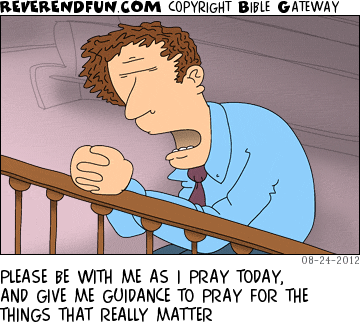
http://www.reverendfun.com/?date=20120824

I'm not saying that God only hears prayers that are super organized and theologically outlined and footnoted and so on. Sometimes, the only prayer we have in us is “O, God help.” “God, be merciful to me a sinner.” And those are good prayers. They are sincere, sensible and affectionate. They are addressed to the God of Scripture in Christ, aided by the Holy Spirit. And so on. So we don't have to over think this.

But I think we do have to think. Our prayers can become very ritualistic, selfish, and unbiblical, which means they are also meaningless and powerless. Just as we need humble self examination in general (as per my last post), our prayers could stand a little examination as well. Am I really praying? Or am I just offering up a magic mantra in hopes of getting what I want?

Now, if you'll excuse me....I need to go pray awhile.

Thursday, January 8, 2015

Humble Self-examination

So I've been preaching through John's Gospel for almost...a long time. And we come to chapter 13 which begins with that wonderful portrait of our Lord washing His disciples feet. But the awe of that moment is tainted with the revelation that there is a traitor among them.

As I studied the brief middle section of that chapter, two things about the disciples' reaction jumped out at me. The first, when Jesus says one of them will betray Him, their first response is not for all of them to start pointing at Judas and saying things like “I knew that guy was up to no good.” John says they were “uncertain.” They had no clue. Judas wasn't the obvious villain we sometimes think. There's more on that, but I don't want to just give you Sunday's sermon.

The second reaction, when Jesus says one of them will betray Him, is also that their first response is not pointing at others at all. It's not just that they didn't recognize Judas' traitorous heart, it's that they didn't start wagging fingers and tongues and accusing each other and so on. Instead, as Matthew's account tells us, they each began to ask the question: Is it I?

I'm blown away by that. Humility. A readiness to look at my own heart before I start casting blame on others. What an amazing example. I don't imagine it playing out that way in most churches today. I have a feeling we'd be a little quick to point the blame on others. “Oh, yeah, it must be that guy. I've never trusted him. Or maybe that guy, he dresses funny. Or that guy over there, he always disagrees with me at business meeting.” We would fill our minds with suspects and accusations. But the disciples asked, “Is it I?”

I'm not suggesting living in a constant state of uncertainty and doubt. John ends his first letter to the church by reminding us that he has written to those “who believe in the name of the Son of God that you may know you have eternal life.” That you may know. Confidence in the saving work of Christ is a good thing. And expected thing. But spiritual pride is another. And we are frequently reminded to take a good look, to make our calling and election sure, to see that we are in the faith, and so on.

Humble self-examination. Periodically checking to see that our heart is right. Looking in evaluation before we look out in judgment. Getting the plank out of our own eye before looking to help a brother remove his speck. (That doesn't mean we don't look to help the brother get that speck out, because that's part of the reason we need to get the plank out of our own eye.......but that's Sunday night's sermon, so.......)

I know I need this reminder. I'm pretty certain most things are other people's fault. I'm pretty sure I've got it right and the rest of y'all need to get some things figured out. So, yeah, I need to hear this. Humble self-examination. Searching my heart before looking to blame others. If a relationship isn't what it should be: Is it I, Lord? If there's a disagreement here or there: Is it I, Lord? If there's something that needs to be done: Is it I, Lord? Is there an obstacle that needs to be removed: Is it I, Lord?

Maybe it's not me. In this case it was Judas. The other guys were innocent of this particular crime. They weren't the traitors after all. Yet, we have much to learn from their first look being inward instead of outward. May we all example such humble self-examination.

Monday, January 5, 2015

Deacons = Servants

Can I brag on our church's deacons for a minute? Well, it is my blog, I guess. You don't have to keep reading if you don't want. But if you want a great example of what Biblical deacons look like, read on.

I have to confess that over the years I've been blessed to work with many good deacons. May sound strange if you've been around church life enough to hear the jokes/horror stories about the relationship between pastors and deacons. And honestly, I've had a few of those as well, as I'll mention. But for the most part, I've been able to serve with humble men who serve their church. The group I serve with now is the cream of that crop, though.

The aforementioned horror stories usually have something to do with power mad individuals who think being a deacon in the church means “I get to run things.” And I have come across one or two of those. They are domineering, they think their opinion carries more weight than everyone else's, they throw little tantrums if they don't get their way, which usually results in pastors getting fired. (Hmm, my flying fingers originally typed “fried.” Typing accident, or subtle truth getting out?) Fortunately, I've only come across one or two mild forms of that guy in nearly 25 years as a pastor.

The other typical problem is a bunch of weak willed individuals who cave under pressure from this or that group in the church to do this or that thing, or to not do this or that thing, and they end up merely as puppets. In this scenario, the deacon is still seen as an “authority” figure. It's just that instead of wielding that power on his own, he is the lackey of political groups within the church. Again, I've come across a few of those, been on the receiving end of their puppet power punches. No fun.

In both of those situations, the main problem is that people see the deacons as some sort of authority figure who runs the church. Whether they run it on their own, or at the behest of others, they are still trying to run things. That's not what deacons do.

In Acts 6, when those first deacons are called out, they are called out as servants. They are called out to settle petty disputes in the congregation so the apostles can focus on preaching and praying. The Greek word for deacon literally refers to one who runs errands. It's an attendant, even one who waits tables. In a word: deacons are servants. And that's what our guys do.

No one is perfect. I know that. Our men aren't perfect either. But they hold the role of servant very well. They care about our church family. They serve them. When I ask any of them to fill this or that role, they humbly accept. When folks are upset, these guys jump in and want to make things right, but in a biblical way, not a pandering to the power hungry.

Honestly, they've all caught flak for their servant role. Some want to use them in that “authority” role, as puppets. And when these guys don't give in to that, they've been accused of being my lackeys. As if I have some sort of power over them. What those folks don't know is how many times these same guys have “called me on the carpet.” Again, not in a power mad way, but in a biblical exercising of their responsibility to the church. If a ministry is not operating the way it should, including the pastor's ministry, these guys aren't afraid to step up and say, “we need to address this, work on this, fix this.” I appreciate the humble way they do that.

A few years back I asked them to come early for church to meet with me and pray before each service. Our service is at 9am, which means they then have to come at 8:30. That means their wives have to come early as well, or they have to make other arrangements, bring two cars, whatever. Not one of them complained. They all agreed happily, and come faithfully. In fact I have to show up earlier every Sunday now to get my “stuff” done, because they usually show up even earlier than the 30 minutes I asked for! They are servants.

Not everyone understands the difference between “serving” and “ruling” in the church. Whether it's pastors, or deacons, or committees, or whatever. Folks often overlook the truth that Biblical leadership means servant leadership. Leading by serving, not by ruling, or as the apostle Paul calls it “lording it over” others. I appreciate so much that these men get the difference, and seek to lead by serving our church.

This may not mean anything to anyone but me. It's sort of a personal reflection. But my prayer is that you may experience godly, servant leadership in your church as well. I pray God would raise up men to serve you and your church in this way. If you are a deacon, look to serve for Christ's glory, not man's. If you are a pastor, I pray not only that you are blessed to work with men like this, but that you are a servant leader yourself. Because in the end, what I think of when I consider these men, is: I want to be like that, too. I want to lead by serving. I don't want to be a “ruler.” I have one of those already. His name is Jesus. And ultimately I want to be like Him. And ironically, He lead by serving as well. There must be something to that.

Saturday, January 3, 2015

Praising God for the Destruction of the Wicked?

So I'm driving down the road listening to Shai Linne, one of my favorite Christian rappers (go ahead and hate me for it, I don't care). And I come to one of my favorite songs simply titled: C.H.R.I.S.T. It's a simple song of praise for the glories of Christ. Shai says some basic truth, asking “right?” And the background singers/crowd yells “Yeah!” Here's a sample:

Christ created all things, right? (Yeah!)
Lord of Lords, King of Kings, right? (Yeah!)
He came through a virgin birth, right? (Yeah!)
God in the flesh walked the earth, right? (Yeah!)
Jesus lived a perfect life, right? (Yeah!)
He died as a sacrifice, right? (Yeah!)
He was raised on the third, right? (Yeah!)
And we know this from the Word, right? (Yeah!)

You get the idea. It goes on to hit the five “solas” even at one point. Great song. But as I'm listening to all this great truth, listening to all this praise for Christ, I'm suddenly taken aback by one section.

He ascended to His throne, right? (Yeah!)
He’s gonna come and take us home, right? (Yeah!)
He’s gonna judge all the earth, right? (Yeah!)
He’s gonna show what He’s worth, right? (Yeah!)
He’ll send the wicked to hell, right? (Yeah!)
But with His people He’ll dwell, right? (Yeah!)

I'm singing/yelling “Yeah!” right along with them, but then I stop. Wait a minute. What did he just say? He'll send the wicked to hell, right? And we say “Yeah!”? Is that the response I should have? Should I really praise God for the destruction of the wicked? Well, according to Scripture, yes.

Why? Because the destruction of the wicked is a display of the glory of God, the justice of God, the righteousness of God. Jonathan Edwards once gave a message on “Wicked Men Useful In Their Destruction Only.” After showing how God's justice and righteous are highlighted, he directly addresses the issue or our response. He says this:

The destruction of the unfruitful is of use, to give the saints a greater sense of their happiness, and of God's grace to them. The wicked will be destroyed and tormented in the view of the saints, and other inhabitants of heaven. This we are taught in Revelation xiv. 10. "The same shall drink of the wine of the wrath of God, which is poured out without mixture, into the cup of his indignation ; and he shall be tormented with fire and brimstone, in the presence of the holy angels, and in the presence of the Lamb." And in Isaiah lxvi. 24. "And they shall go forth and look upon the carcasses of the men that have transgressed against me : For their worm shall not die, neither shall their fire be quenched, and they shall be an abhorring unto all flesh."

When the saints in heaven shall look upon the damned in hell, it will serve to give them a greater sense of their own happiness, seeing how vastly different their case is from their own. The view of the doleful condition of the damned will make them the more prize their own blessedness. When they shall see how dreadful the anger of God is, it will make them the more prize his love. They will rejoice so much the more that they are not the objects of God's anger, but of his favor; that they are not the subjects of his dreadful wrath, but are treated as his children, are taken near to him, to dwell in the everlasting embraces of his love.

When they shall see the misery of the damned, it will give them a greater sense of the distinguishing grace and love of God to them, that God should from all eternity set his love on them, and make so great a difference between them and others who are of the same species with them, are no worse by nature than they, and have deserved no worse of God than they. When they shall look upon the misery of the damned, and consider how different their own state is from theirs, and that it is only free and sovereign grace that makes the difference, what a great sense will this give them of the wonderful grace of God to them! And how will it heighten their praises! With how much greater admiration and exultation of soul will they sing of the free and sovereign grace of God to them!

When they shall look upon the damned, and see their misery, how will heaven ring with the praises of God's justice towards the wicked, and his grace towards the saints! And with how much greater enlargement of heart will they praise Jesus Christ their Redeemer, that ever he was pleased to set his love upon them, his dying love! And that he should so distinguish them as to spill his blood, and make his soul an offering, to redeem them from that so great misery, and to bring them to such exceeding happiness!

Wow! I once heard Paul Washer talk about the vileness of our sin, and the blight that our sin is on creation, and how man compares with the rest of creation in that sense, and creations response, and thought it was a bit intense. He says this:

God said to the stars, each of which is large enough to consume a dozen of our suns, ‘You go there, and you will be called this, and you stay there until I tell you otherwise.’ And the stars obeyed. He said to the planets, ‘you go there, and will be this color, and will go in this path, and will reflect light in just this way, and you continue to do all that until I tell you otherwise.’ And they obeyed him.
 
And He said to the mountains, arise and come forth and they obeyed and rose up out of the ground. And He said to the valleys, ‘Cast yourself down’ and they obeyed Him. He said to the monsters of the deep dance in this way, and they danced in obedience.

And then he said to you (man) come follow me, and you said, ‘No!’” Washer concluded by saying, “Our sin is so horrible, so vile, such a blight on creation that when you take you first step into hell, all of creation will rejoice because God finally got rid of you!”

Again, wow! But hopefully you get the point. God is so holy, so righteous, so perfect in all that He does, that even His justice on display in the destruction of the wicked elicits praise from all of creation, including His saints. It's not joy over the pain and suffering of men. It's not a joy that delights in the punishment of the wicked for the sake of punishment. It's a joy based on the perfect judgment of a holy God. It's joy based on the reality that our God is a God who makes all things right. It's a joy that centers on Christ and the salvation He offers that rescues us from such destruction, while at the same time knowing that destruction is right and good and worthy of praise.

I still struggle with this, I'll be honest. I know that none of this means a delight when those who oppose us “get theirs.” It's not a petty, vindictive thing. In this life, I should see that coming destruction and be so passionate about seeing those around me avoid it that I faithfully and frequently share the gospel, hoping and praying that those around me are saved from such an end.

But at the same time, I know that such an end is right. I deserve it myself. Only the grace of God keeps me from it. And it is right to glorify God for bringing such an end to those who spent their lives in hatred of and rebellion against Him. I pray God will teach me the truth of this, help me get the right balance of it, and praise Him for His justice as well as His mercy.

Thursday, January 1, 2015

New Year, New Beginnings

I admit I was a little off at the end of the year. A little tired. A little frustrated. A little of a lot of things. Hence the “death knell” post.

But as we look to this new year I'm reminded of the blessing of new beginnings. In fact, isn't that what our faith is all about. All things becoming new. God bringing life to the dead. New chances. New opportunities. New life. And continual newness.

What a horror it would be if God looked down at our sin and filth and said, “You know, I'm a little tired. A little frustrated. A little of a lot of things. Let's just end it.” Oh my! Praise God His mercy endures forever. Praise God He continues to bring newness, to renew the strength of the weary, to restore the wandering son.

And so, even though the things that cause weariness and frustration haven't changed, I am resolved to focus on newness and joy and strength in Christ instead. (AHH! A new year's resolution. I said I wasn't going to do those! Oh well)

To mark the newness, I've revamped the look of things. I'm not that computer savvy, but thanks to the fancy tools Blogger provides, I was able to come up with some new stuff. Might even change it again. I'll wait and see how it grows on me.

I still don't know if the productivity will increase. But the “new” part is I don't really care. I'm not going to do this because I think I have to. I like the catharsis, as I've mentioned frequently before. So I'll do it for the joy of it, for the help in clarifying my own thoughts, for the entertainment of the 3 people who read this, simply sharing the thoughts as God gives them to me, for His purposes and for His glory. And it'll be a great new year.

So in looking forward to the newness, the new year and all, keeping in perspective that God's plans and purposes should always be foremost in our hearts, here are Samuel Medley's words from 1789 in looking at “Another Year.”

Father of mercies! God of love!
Whose kind compassion still we prove,
Our praise accept, and bless us here,
As brought to this—another year.

We sing Thy goodness all divine,
Whose radiant beams around us shine,
Tis through Thy goodness we appear
Preserved to this—another year.

Our souls, our all we here resign;
Make us, and keep us ever Thine;
And grant that in Thy love and fear
We may begin—another year.

Be this our sweet experience still,
To know and do Thy holy will;
Then shall our souls, with joy sincere,
Bless Thee for this—another year.

Still, Lord, through life Thy love display,
And then in death’s approaching day,
We’ll joyful part with all that’s here,
Nor wish on earth—another year.

Monday, December 15, 2014

Death of a Blog?

We all know that life moves in cycles and seasons.  We start out young and learn our way around.  You then "hit your stride" out to conquer the world in youthful exuberance.  Eventually, age and wisdom take over, and maybe you slow down, or redirect.  Eventually, it all catches up and things really start to slow down, etc.  It varies from person to person, but there is a definite pattern to it all. 

I think I see that in this blog as well.  In 2007 I hit the online world with my little page and slowly started to learn my way around.  Growing and learning and getting the hang of things, the pace picked up a bit.  At some point, I "hit my stride" and was spouting off about anything and everything.  I even got a little nationwide boost during an election cycle in which my words prompted interviews from a St. Louis paper and even the NY Times, which both quoted me.  I felt like a star. 

But then middle age set in, it became more steady and plodding, maybe.  Hopefully more mature...nah, never mind on that one.  And then things started slowing down.  Maybe life got busier, maybe I got less opinionated...


...Sorry, had to take a break and catch my breath after "rolling on the floor laughing."

Anyway, it seems now that this thing has become like a sad, neglected old relative in a nursing facility.  I only come by to visit once a week or so, and then don't seem to think about it for awhile.

Again, maybe it's a life phase or something.  I still enjoy doing this.  I started in large part as a cathartic experience.  Just being able to share thoughts about random things.  Some important.  Others not so much.  Some things I couldn't really share from the pulpit. Other things which I had just shared from the pulpit.  All it all, a fulfilling experience for me whether anyone reads it or not.

But I've been feeling guilty about the lack of both quality and quantity lately.  And it's made me wonder what the future holds.  Maybe I'll get with it again.  Maybe I'll just let it fade into the sunset.  Just don't know.  The fact that I'm taking time for my weekly visit to even ruminate about this should tell you something.

I also read an online "acquaintance" who recently wrote about becoming bored with blogs.  Maybe that's it.  Maybe the time has passed.  I know there are still several places out there that I enjoy stopping by and reading, depending on time, etc.  So maybe these things still have a place. 

Anyway, the title of this blog says it contains "random thoughts" and these have been about as random as it gets.  At least I'm living up to the billing, though.  

If the end is near, it's been a fun ride.  If there is still life left, I look forward to what may still come.  Either way, God is good, grace is amazing, and... I need coffee!

Monday, December 8, 2014

The Awkward Handshake...and other "Traditions"

I'm not sure what's behind the "tradition" of the pastor standing at the head of the casket after a funeral service.  As the "viewing line" comes around, they all look at me with this bewildered look, like "am I supposed to shake your hand?"  I know that the few times I've been to services that I'm not conducting, I do appreciate the chance to thank the minister for his words of encouragement, etc. so maybe that's all it is. But most folks still give that confused look.

However, if the first person shakes my hand, then the rest of the line sees that and has this, "Oh, I guess I have to shake your hand now, too" look.  If it's a church member's service and it's other church members, the handshake is real.  For folks I don't know, it can be very awkward. 

I share that simply because I've made the decision that since 90% of all funerals I attend end with me up front offering this awkward handshake, I think that when I die I should leave instructions for the funeral director to embalm my body with my hand hanging out of the casket so that my last funeral can end like all the others: with me up front offering folks an awkward handshake.  (For the record, this probably won't actually happen since upon sharing the idea with my wife she informed me there was "no way" she was touching me when I'm dead!  Oh, feel the love.)

This brought to mind a recurring idea for me: why do we do the things we do?  Why do the bride and groom stuff cake into each other's mouths at weddings, for example? Or why do you have to have different forks for salads and desserts?  These are the things that keep me up at night.

I know that there are probably good reasons for most "traditions" in the church and elsewhere.  If I had the time and patience I could probably track those reasons down.  I don't mean to make light of those things that really do have meaning.  But so much of what we do, we simply do because...that's what we do.

Simple things like church bulletins.  Insignificant for most folks, but let the copier break down and go a Sunday without any, and while most might not really care, you'll have a couple of folks at least who will have a meltdown.  "What?! No bulletins?  We won't know what song is coming next! How will we survive?!"  Maybe not that bad, but we get used to things like that, and begin to think they are a vital part of things when they really aren't.

Or the other hand shaking thing, the one where we take time in the worship service to walk around and shake hands.  We do this before we even begin the actual service, but I've been places where the service starts, and then we stop to shake hands, and then we try to go back to worship.  Seems an odd insertion.  And again, some folks will freak if we don't do it. 

This one I really did experience.  We didn't do the "greeting time" one Sunday years ago, and I had someone come up after the service and was very irate about it.  "Why didn't we have the greeting time?  Why are you trying to change things?  Etc."

Those are simple things.  But the point is, we ought to take time now and then to consider the things we do in the church, or in our families, or wherever.  And we need to ask ourselves, are these meaningful things, useful things, productive things, Biblical things?  Or are they just traditions, habits, rituals, things we don't even know why we're doing them. 

Just some thoughts.  And if you do for some reason happen to attend my funeral, don't be shy, go ahead and shake that hand.  It will mean a lot to me.   

Monday, December 1, 2014

Final Feelings on Ferguson (maybe...)

Years ago, conservative pundit Rush Limbaugh started using a phrase to describe the liberal politicians and their media mouthpieces.  He called it "symbolism over substance."  The point being that those on the "left" were more concerned about good sounding ideas and such than actual, real world ideas and legislation.   That idea has now completely taken over our nation, it seems.

The headline in this past Sunday's paper said that the events happening in Ferguson, MO surrounding the black young man who robbed a local store and was then fatally wounded in a confrontation with a white police officer, was the beginning of the "new civil rights era."  Really?  This is the kind of case those fighting for genuine racial harmony are going to build their platform on?  One where the actual facts have nothing to do with a racial issue at all?  Symbolism over substance.

Meanwhile, across the city in St. Louis proper, several Rams players took the field with their hands up in the air mimicking the chant of the Ferguson protestors: "Hands up, don't shoot."  Never mind the fact that the evidence in this case, including the autopsy, show that if the young man would have actually demonstrated this attitude and posture, he might still be alive.  But as I stated in a previous post, facts don't seem to matter when it comes to issues of race.  Now, it's symbolism over substance.

As I also mentioned previously, I grew up about 30 miles from Ferguson.  While in the area over Thanksgiving, we watched in disappointment as protestors filled local shopping malls on "Black Friday", laying in the floor to obstruct shoppers, even closing a couple malls down.  Now I've never been a Black Friday shopper, so it doesn't bother me directly, but what of all the workers in those malls who are losing paychecks because of this.  Does this really help the "cause" of the protestors?  Or does it just create more animosity and division?

Furthermore, large groups of people on private property protesting like this should have led directly to arrests.  If I took a group of folks to the local mall and started preaching the gospel in the center court, I can guarantee I would have been escorted out quickly and firmly by security.  But this is a "racial" issue, so...  These actions really mean nothing constructive. It's just symbolism over substance. 

There are real problems in this world.  As Pastor Voddie Baucham (who is black by the way) pointed out.  "There is indeed an epidemic of violence against black men. However, that violence, more often than not, occurs at the hands of other black men. In fact, black men are several times more likely to be murdered at the hands of another black man than they are to be killed by the police. For instance, in the FBI homicide stats from 2012, there were 2,648 blacks murdered. Of those, 2,412 were murdered by members of their own ethnic group. Thus," Pastor Baucham says, "if I am going to speak out about anything, it will be black-on-black crime; not blue-on-black"

Where are all the protests for genuinely innocent young black men and women being killed routinely by gangs and thieves and such?  Where are the outbursts when a white young man was killed by a black police officer?  Where are Sharpton and Jackson and the others when two young black men torture, rape and kill and young white woman?   Where are the mall stoppers when truly innocent victims are being slaughtered left and right each and every day?  Where are the cries of outrage when black business owners have their businesses destroyed by "protestors"?  Oh, those lives don't matter, I guess.  Or maybe it's that those cases don't feed their political machines, fill their pockets with donations, and help push their race-baiting agenda.  Symbolism over substance.

Once again, please hear me.  The death of Mike Brown was tragic.  I pray for his family.  I pray for his friends and community.  This is a tragic loss of life.  But the evidence was gathered, presented to a grand jury that was already "seated" long before this case came along, witnesses were interviewed, and the result was that the officer here did nothing criminal, worthy of charges.  Why can't we focus on those out there who are guilty of criminal actions, now including many of the rioting, looting, so-called protestors in this case?  Ah, but that would break the symbolism over substance cycle.

I know men's hearts are wicked and depraved.  Sin was in the heart of Mike Brown as well as Officer Darren Wilson.  Sin is in the hearts of the protestors.  Sin is in my own heart.  But my prayer is that the power of the Gospel would prevail, that men's hearts would be changed, that people would start focusing on the substance, the real problems, the real issues, and stop focusing on symbols like this case where the facts don't support at all the protestor's claims.  

I long for the day when we can see one another simply as people, not white people, or black people, or whatever.  And when real issues of race arise, they ought to be addressed.  But the response by so many in this particular case, looking at the symbolism over substance, just leads to frustration on both "sides" and does nothing to genuinely help bridge the gap.  May God truly change some hearts, may folks wake up to the real issues, may genuine victims begin to have their cause championed, and may peace truly come to our communities.  Not just the symbol of it, but the substance of it.