For it is by grace you have been saved...

Thursday, April 3, 2014

C is for Cheryl

Along about 1982 I started going to church (oh, that could have been my "C" word!).  I can't say it was because I longed for truth, or sought to encounter God, or anything like that.  It was because of a girl.  I started chasing after a girl at school and realized that she and her friends spent most of their time at church or church related functions.  Being the bright, logical guy I am, I deduced that if I wanted to see her...I'd have to go to church. 

Her name was...Tina.  I know.  Not a "C" word.  Actually, her last name did start with "C", but that's another story.  Anyway.  Tina did "date" me for awhile, but soon decided to move on.  In the meantime I had become a Christian (now there's a "C" word for you.  Christ is as good as it gets!).  Now then, being a new believer I realized I should only be interested in other believers, and since the only girls I knew who were believers were the other girls at church, that's where I went.  Surprisingly (to me) this didn't sit well with my "ex."

Also in this little story is Tina's best friend...Cheryl (finally!).  Cheryl, being Tina's best friend, promised her best friend that she would never date me like the other girls at church were doing.  And she was good to her word...at first.  She turned me down the first 3 times I asked her out.  But I'm persistent.  And she finally agreed.  And the rest is history.  (It's ok, though; Tina forgave us both and sang at our wedding!)

Cheryl and I will be celebrating our 25th wedding anniversary this summer.  25 years!  Oh, the grief that woman has put up with in that time!  I've dragged her through ministry on an Indian Reservation, a homeless ministry, several small churches.  It's always been a struggle financially, especially when you add in four children!  But she's never complained.  Never asked for more.

This woman is the very portrait of what a godly, Christlike woman should be.  She is an example of faithfulness, humility, service, patience, encouragement, and dozens of other descriptive terms I can't quite think of right now.  Oh, here's one:  True Love!  As in Princes Bride kind of true love.  As in Ephesians 5 kind of true love.  As in everything in between kind of true love. 

I literally can't imagine my life without Cheryl (and yes, daughters, I am using that word correctly).  She anchors my life in ways I can't even describe.  She lifts me up when life beats me down, even when life might have been right in doing so.  She does all those things in all those corny love songs we used to listen to in the 80s.  She is, next to Christ, the greatest blessing in my life.  I thank God for her daily.  And now, after writing this, I can't wait to get home and hug her and thank her again for agreeing to spend this life with me. 

Honorable mention for "C" word:  Coffee!

Wednesday, April 2, 2014

B is for Books

This is a no-brainer.  When trying to think of a word beginning with "B" to write about for this alphabet challenge, the word "Books" just screams at me.

I've shared here before what a bibliophile I am.  Books are amazing things.  My office library has nearly 2,000 volumes (as my daughter who has been cataloging it for me can tell you!).  Our home is likewise a depository for myriads of volumes (I just wanted to write a sentence with smart sounding words!).  As a homeschool family, obviously, books are pretty important. 

Our kids have picked up the love my wife and I share for books, thankfully.  The oldest is graduating with an English degree and has been working the last couple years at the campus library.  Her little sister is looking to follow in her footsteps and works one day a week at our local library.  Both the boys love getting lost in a good story (even if they do spend more time reading Garfield books!).  Books, books and more books in our family!

Of course, we're not alone in this passion.  Henry Ward Beecher famously said "It is a man's duty to have books.  A library is not a luxury but one of the necessities of life."  Charles Spurgeon wrote in his Salt Cellars: "A good book is the best companion...If love, joy, laughter, sorrow please my mind, Love, joy, grief, laughter in my books I find."

And of course, near the end of his life, even the Apostle Paul shows us how important his books are.  He tells Timothy: "When you come, bring the cloak that I left with Carpus at Troas, also the books, and above all the parchments." (2 Timothy 4:13, ESV)  What does he want in his captivity?  Books.  

Much, much more can, and has been, said.  But I'll leave it at that.  Books are wonderful.  Put down the remotes, turn off the laptops and tablets, and go read a book! To that end, here's a nice visual reminder from my friend Eddie over at Calvinistic Cartoons.
http://calvinisticcartoons.blogspot.com/2014/03/26.html

Tuesday, April 1, 2014

A is for Allons-y!

For the last couple years I've watched a few of my blogger "friends" do this little A to Z challenge for the month of April.  The idea is simply to post one entry for each letter of the alphabet throughout the month (Sundays excluded).  With the advent of more and more social media, blogging is falling by the wayside in many instances.  And I've noticed my own output has lagged recently.  So I thought this was a good little boost.  So let's go...

Which is why "Allons-y" is our word for letter "A."  It's French for "let's go" and seemed appropriate to begin our little monthly challenge.  It also has some family connections for me. 

First, the French connection: I actually took French in high school and college.  One year in high school for which I won the "French Award", whatever that means.  And three semesters in college.  You'd think with all that in my head I'd remember a little French.  But the running joke in our family is that all I can remember is "Où est le W. C.?"  Translation: Where is the bathroom (water closet)?  I figure if I'm lost in France that could be an important question.  

Second, our youngest daughter has been taking French for the last year or so.  Which has led to the family phrase of gratitude "mercy buckets" (said with thick redneck drawl).  The French for "thank you" is obviously "merci beaucoup" which in a family of Ozarkians playfully becomes "mercy buckets."  Anyway...

Then there is the Doctor Who connection. I've revealed here that our family is a big fan of the BBC Doctor Who show, for me dating back to the late 70s/early 80s with the Fourth Doctor, Tom Baker.  But once the show was brought back, David Tennant's Tenth Doctor became a family favorite.  One of his "catch phrases" is...you guessed it: Allons-y!  (By the way, a word to the BBC regarding the new 12th Doctor's adventures: Allons-y!  Come on, let's go already!)

And, of course, as already stated, it's a good way to kick off the A to Z Challenge.  So, let's go.

Monday, March 31, 2014

How Important is Truth in Telling the Truth?

I'm sure you've heard this one.  "The Bible says "do not fear" exactly 365 times.  That's once a day for every day of the year!  Isn't God great?"

Well, it's a cute idea, but is it true?  I've looked myself for every variation of the "fear not", "do not be anxious", etc. and don't come up with nearly that many.  I've researched and found others who came up with more than I did, but still not 365.  The only people who claim 365 don't provide an actual list to back it up (if you know of one, please let me know and I'll retract all of this!).  Furthermore, the Hebrew calendar had anywhere between 353 and 383 days a year, so the 365 only affects us New Testament era folks.  Poor Old Testament saints didn't get that promise, I guess. 

Here's the point:  How important is it that we use truth when teaching the Truth?  When presenting the gospel, how important is it that we share stories, illustrations, quotes, etc. that are actually true?  

How about the center of the Bible deal?  Google it, I'm sure it will come up.  The claim is that Psalm 118 is the center of the Bible and that 118 is the center verse, which says, "it is better to trust in the LORD than to put confidence in man." The story then says:  "The next time someone says they would like to find God's perfect will for their lives and that they want to be in the center of His will, just send them to the center of His Word!"

Cute.  Except the center chapter is actually Psalm 117. The center verse is actually Psalm 103: 2, out of 31,101 total verses (depending on translation).  Psalm 118:8 isn’t even the center verse of that chapter. But don't let the facts get in the way of an inspiring "truth."  A couple other examples:
http://www.reverendfun.com/?date=20071001

Years ago I repeated the story of James Bartley in a sermon.  I've since repented. If you haven't heard it, the story says this sailor went overboard, was swallowed by a whale and live to tell about it!  It was repeated in novels by well known authors, and has been used for decades to "prove" that Jonah's story could happen.  The problem?  One, research has shown the story to be a fabrication.  And two, why do we need some modern story to "prove" the Bible?  Do we have to go find someone else risen from the dead to "prove" the Resurrection?  

Or how about those questionable attempts to "prove" Joshua's "missing day?"  Seems to me the truth of God's Word should stand on it's own without any need for us to prove it with modern stories, NASA computers or anything else.  

But the question still remains, is it ok to repeat falsehoods as long as we're just trying to illustrate the Truth.  Take this example.  There is a well known story about a little homeless boy who is directed to a house that can help him, and all he has to do is mention "John 3:16."  The point of the story is that the love of God demonstrated by his children to those in need is a beautiful thing.  It's a sweet story.  But is it true? 

Well, I've seen many variations of the John 3:16 story.  Most say the boy was in Chicago.  A few say New York.  One version of the story makes it an Irish tale in Dublin.  I found one site that sells a little children's story book, but it's unclear whether it's just a story or if it's based on truth.  We even had a speaker come to our church and claim this happened in one of our Baptist Children's Home.  Ouch!  

There's the point again.  It's ok to tell stories and use illustrations, as long as they are told as stories and illustrations.  But when we start claiming things as facts, does that undermine the very Truth we are telling?  Don't you think it makes Christians look foolish and gullible at least, and just dishonest at worst?

Now, I admit that sometimes it's easier to repeat the story or the "fact" than to check it out.  I wasted quite a bit of time trying to research some of these things over the years.  But I think it's worth it to be sure we're sharing truth and not just amusing anecdotes. 

My last post was a cry for discernment in the church.  Let's not buy into and pass along every little thing just because we read it on the net, etc.  This is more a cry for integrity.  Let's be sure that the things we claim as true are true, not just cute.  It's not enough for it to be inspiring or clever or goose bumpy.  Let's make sure that as people whose lives have been changed by the Truth of Christ, that our lives reflect truth as much as possible.

Wednesday, March 26, 2014

Another Call for Discernment

I've written before about the sad lack of discernment in the church today.  Too many people take their theology cues from novels and movies and the latest Christian best seller rather than from the Bible.  

I saw the movie trailer the other day for the book about the four year old who goes to heaven and comes back with "amazing" messages.  And people are eating this stuff up. Like we should believe a four year old's dreams more than God's written word.  His isn't the only "back from heaven" story, just the most recent/popular. 

It did my heart good to walk into a used book store the other day and see that this completely secular store had a better grasp on where such books should be categorized.

Then there is this example from the world at large.  A friend recently posted a fake/satirical article about an athlete "coming out" as gay.  It was obviously written as a joke, even though it was in poor taste on so many levels.  And yet, by posting it online, and then having dozens of folks post it on social media, the story takes on a life of itself because after all, if we read it on the internet it must be true, right?

It's that mentality that has so infected the church in recent years as to become extremely dangerous.  So often stories are spread as hoaxes, about this or that legal challenge, about this or that political issue, about this or that star who said this or that; and Christians run to their facebook and email to pass it along at lightening speed without ever checking the veracity of it.

When did we become a Church full of people who are so taken in by emotional books, and knee jerk emails and all the rest; instead of a people of the Book?  When did we start basing our theology and our practical daily lives on trendy books and movies instead of the revealed Word of God? 

Things have gotten so bad that any time some book or movie comes out claiming to be Christian, whether it's the back from the dead story or the latest movie about Jesus, Christians go crazy in support of it without once stopping to really examine if the things being taught here are Biblical.   Obviously no book or movie or person is going to be perfect, but can't we at least have a little discernment?

I'm begging you: stop and think!  Open your Bible once in awhile. We ought to be striving for the maturity Paul writes to the Ephesians about "so that we may no longer be children, tossed to and fro by the waves and carried about by every wind of doctrine, by human cunning, by craftiness in deceitful schemes." (Ephesians 4:14)

I know I've said most of this before.  I know it will probably fall on deaf ears.  But please, Church, can we exercise a little discernment!

Tuesday, March 18, 2014

More Amazing Grace

No, not grace that’s more amazing than that which we know in Christ.  There is no greater grace.  But there are more and more and more songs to sing about it.

How do we decide which hymns are the great ones?  Obviously, popular use has a lot to do with it.  If a song reaches people, touches them in some way, inspires them, then they love to sing it over and over.  But in a sense, this is such a subjective thing. 

Times change, tastes change, mindsets change.  What speaks to one generation may not speak to another, etc.  Of course, there are those songs that span the generations.  Take Amazing Grace for example.  Most would agree that this is one of the greatest hymns ever.  I would be among them.

Yet, it’s interesting to see how others have viewed things.  As you may know, John Newton wrote a lot more songs than just that one.  Most people know Newton as the author of Amazing Grace, or as he called it, Faith’s Review and Expectation.

And many know his story: slave ship captain, gloriously saved, called to preach, writer of hymns.  The epitaph he wrote for himself tells that story.  Etched in stone are Newton’s own words:  John Newton, clerk, once an infidel and Libertine, a servant of slavers in Africa, was, by the rich mercy of our Lord and Savior Jesus Christ, preserved, restored, pardoned and appointed to preach the Faith he had long labored to destroy.”

Quite a story.  Maybe a bit less know is the fact that in addition to books full of sermons we have from the old preacher, we also have hundreds of other hymns that came from his pen.

In the late 1700s, Newton got together with poet WillamCowper to put together a collection of hymns known as the Olney Hymns.  Actually, the two of them were part of a weekly bible study and prayer group, and they set out to write a new song for each meeting.  Pretty amazing, isn’t it?

And so why is it that out of all those songs, most people would only know Amazing Grace?  A matter of taste, I guess.  It’s interesting to not that when Charles Spurgeon was compiling a hymn book for his church in 1866, he included several of Newton’s songs.  Amazing Grace was not one of them.  As I said, a matter of taste I guess.

One song that Spurgeon did include, in my mind, should be another Amazing Grace.  The song carries with it the same passion for grace, the same recognition of the depth of our sin, the same rapture in the glorious grace in Christ that rescues us from that sin.  Interestingly enough, it’s even written in the same meter, so we can even sing it to the same tune (which as you know wasn’t original with Amazing Grace anyway).  So here is some more amazing grace from the pen of John Newton.  Enjoy.

Approach, my soul, the mercy-seat,
Where Jesus answers prayer;
There humbly fall before His feet,
For none can perish there.

Thy promise is my only plea,
With this I venture nigh;
Thou callest burden’d souls to Thee,
And such, O Lord, am I.

Bowed down beneath a load of sin,
By Satan sorely press’d,
By war without and fears within,
I come to Thee for rest.

Be Thou my Shield and hiding Place!
That, shelter’d near Thy side,
I may my fierce accuser face,
And tell him Thou hast died.

O wondrous love! to bleed and die,
To bear the cross and shame,
That guilty sinners, such as I,
Might plead Thy gracious Name.

“Poor tempest-tossèd soul, be still;
My promised grace receive:”
’Tis Jesus speaks—I must, I will,
I can, I do believe.

Monday, March 17, 2014

Happy St. Patrick's Day

I'm a big fan of Celtic music and some of the rich history of the Celtic Church.  Here are a few items to help celebrate the day, from entertaining, to informing, to just plain fun.

First, informational...

Next, a piece from my favorite hymn writers...

 And now a favorite from Ceili Rain, a great Celtic band...

 And for just plain fun...

And then even more fun...

Tuesday, March 11, 2014

The Upside-down of Grace

I found a haystack in a needle
I caught an angel in a lie
I saw a hypocrite in heaven
Remove a log from both his eyes
I saw an anvil float on water
Water running up a hill
An old cheater keep his promise
And his hand’s outside the till

I saw the last get in first
I saw the best in the worst
By moving forward in reverse
And back again to love
Holy, holy love
 (from "Forward in Reverse"
on the Daniel Amos album Dig Here, Said the Angel
Music by Daniel Amos, Words by T.S. Taylor
©2013 Shape of Air Music)

I admit that I don’t always get lyrics to songs.  Sometimes the writers are just too clever, too deep, too obscure, too whatever for me.  And in the past, Terry Scott Taylor of Christian music legendary band Daniel Amos (DA) often had that effect on me. 

But these lyrics I get.  And they remind us of an often overlooked reality about the nature of grace.  Grace is a radical thing! 

Those of us blessed to live in the great nation of the United States of America need to admit that there are some curses that go along with the blessings.  Namely, because we have so many freedoms, so many opportunities, we’ve developed an “entitlement” mentality.  Now apart from the whole political discussion of what that mentality leads to, there are some theological implications as well.

In short, we kind of think we deserve our salvation.  In this land of “independence” and “freedom” and so forth, we think we’ve earned what we have, deserve what we have, etc.  And that carries over to our view of salvation.  Why wouldn’t God want to save me?  I deserve it.

But that misses the radical, upside-down nature of grace.  God saving you is like finding a haystack in a needle, or seeing water run uphill.  It goes against the natural state of things.

We love John 3:16 so much, the idea of God loving so much that He saves.  We forget the context of that verse includes the natural state of each and every one of us:  born into darkness, and loving it.  We are born into sin and love our sin.  What we deserve is the wrath of God; His justice; His righteous anger.  We deserve death, but God gives life.

Ephesians 2:5  says that God, “even when we were dead in our trespasses, made us alive together with Christ--by grace you have been saved.  We know that verse; we think we know what it means.  But I think we overlook the real upside-down nature of it.  This is an amazing, mind blowing, radical, unnatural thing.   Life from Death.  Mercy instead of Wrath.

Not that God’s wrath is ignored.  It’s poured out instead on the very Son of God. More radical, upside-down stuff.  The perfect Son of God treated as a sinner so that sinners can be treated as the sons of God.

As the apostle Paul puts it in 2 Corinthians 5:21, “For our sake he made him to be sin who knew no sin, so that in him we might become the righteousness of God.”  That’s upside-down.  And the DA song includes that part as well.
 
I saw a shepherd king freefalling
Off a throne of mud and straw
He landed on a bed of nails
Proclaiming “Love’s the only law”
I saw a dead man who’d been buried
Walk around outside his grave
The ones we’re told are not worth saving
Are the ones now being saved

Grace.  Upside-down.  Hypocrites in heaven.  Those not worth saving being saved.  I pray we remember the radical nature of that.  I pray we don’t get caught up in the worldly “entitlement” mentality that would cause us to overlook what a truly amazing thing salvation is.  In fact, I think I’ll get down on my knees right now in prayer and praise and adoration and adulation, thanking God for this holy, holy love!

Friday, March 7, 2014

The Evangelical Mush God

Years ago, Leonard Ravenhill quoted a piece by columnist Nicholas Van Hoffman about what he calls "The Mush God."  Hoffman wrote, "The Mush God has been known to appear to millionaires on golf courses. He appears to politicians at ribbon-cutting ceremonies and to clergymen speaking the invocation on national TV. 

 The Mush God has no theology to speak of, being a Cream of Wheat divinity. The Mush God has no particular credo, no tenets of faith, nothing that would make it difficult for believer and nonbeliever alike to lower one’s head when the temporary chairman tells us that...So-and-So will lead us in an innocuous, harmless prayer, for this god of public occasions is not a jealous god. 

You can even invoke him to start a hooker’s convention and he/she or it won’t be offended. God of the Rotary, God of the Optimists, Protector of the Buddy System, The Mush God...is a serviceable god whose laws are chiseled not on tablets but written on sand, open to amendment, qualification and erasure. This is a god that will compromise with you, make allowances and declare all wars holy, all peaces hallowed."

We’ve all seen this mushy-gushy version of god floating around in various places.  But last night, I heard a version of this same god that’s just as popular.  I’ll call him the Evangelical Mush God.  We take the same wishy-washy-ness, baptize it with some evangelical language, prop it up with some biblical references, and call it God.  Let me ‘splain what I’m talkin’ ‘bout.

I took the kids to one of our favorite concert events last year, a yearly event that brings together 8-10 bands for one show, all for one low, low price.  Love it.  Love hearing the different bands.  Love hearing some of our favorite bands.  Love that low, low price!

And each year they also bring along a speaker.  They shut things down for 20-30 minutes and this guy gets up and delivers a message from God’s Word.  Great concept.  Not so great result, in my humble opinion.

Last night the message was about the amazing love God lavishes on us.  Wonderful truth.  He moved to a retelling of the Prodigal Son.  Wonderful parable; great truths.  But here was the problem:

In the course of the message, the speaker made “ha-ha” funny jokes about “what happens in Vegas, stays in Vegas,” which then led to a joke about a friend of his who went to Vegas and brought something back.  Ha-ha.  Like STDs are funny.

Then there was the “wink-wink” reference to Miley Cyrus and her song “Wrecking Ball.”  Never heard the song, but I’ve seen enough to know that the image that song is known for is a naked performer clinging to said wrecking ball.  And we use this reference as a funny moment in a sermon?

Worst of all, as far as I’m concerned is the depiction of God in this rendition of the Prodigal Son.  Now, in his defense, the speaker is just repeating the same thing I’m sure he’s heard over and over in sermon after sermon.  But here’s the portrait.  In the father of that prodigal, he says, we have a picture of God who just loves us so much, and misses us, and longs for us to come home, and sits there in the house day after day, looking out the window, hoping that maybe, just maybe, “this will be the day my son comes home.”   

This is the Evangelical Mush God.  Weak and lonely.  Longing for attention.  As we were told last night, he loves you so much; he loves the good stuff about you; he even loves all your bad stuff.  What?  God loves our bad stuff? 

Here’s the deal. Yes, God loves us.  Yes, God saves us as we are.  It’s true we don’t have to “clean ourselves up” before we come to Christ.  Christ does the cleaning.  But to imply that God loves even our sin is a horrible misrepresentation of the God of Scripture.   And it’s an insult to the cross.

If sin is no big deal, as implied by all the worldly jokes; if God loves even our “bad stuff”, implying that He even loves our sin; then how do we explain a wrath against sin that is so great that it requires the death of the perfect Son of God to overcome.   What about texts like this one:  Psalm 11:5  “The LORD tests the righteous, but his soul hates the wicked and the one who loves violence.”  Not just hates the sin, but hates the wicked. 

God detests sin, and in His perfect justice pours His wrath out on sin.  It’s not to be played with, toyed with, laughed at, winked at.  The Evangelical Mush God looks the other way and loves us anyway.  The God of Scripture pours out His wrath on His Son, so that we can enter into His presence.  That’s the greater portrait of love.

And speaking of portraits.  Does the prodigal son story really show God as such a weak and needy God?  Absolutely not.  Luke 15:20  says, “And he arose and came to his father. But while he was still a long way off, his father saw him and felt compassion, and ran and embraced him and kissed him.”  While he was still a long way off, the father saw.  The father isn’t sitting around wringing his hands waiting.  The father is looking and pursuing. 

Far from weak and lonely, our God is a fierce, passionate hunter.  Think Francis Thomson’s Hound ofHeaven.  He pursues His own, claims them, regenerates their hearts and draws them to Himself in faith.  Our God is a Sovereign King who declares and appoints and chooses, not a doddering old man hoping against hope someone will respond to His call.  (read Ezekiel 36:22ff; John 1:12-13; John 10:27ff; Ephesians 2; etc, etc.)

It’s time to tear down and burn the idol of this Evangelical Mush God.  It’s time to restore the firm foundations of Scripture; to stop pandering to the world and declaring God’s truth.  Time to declare our mighty God in all of His glory, in all of His grace, in all the power of the true Gospel.  Stop making light of sin, and start making much of God. 

Wednesday, March 5, 2014

Why Hell is Necessary...and Good

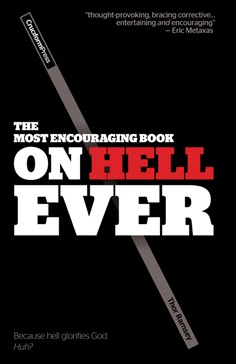
Since my last post was on heaven, sort of, I thought I'd cover the other end of the spectrum.  I've been reading a really good book on Hell by Thor Ramsey.  Now some of you may recognize that name and say, "Thor Ramsey?  You mean the obnoxious comedian guy who used to host the Christian comedy show 'Bananas'?"  And I would respond by saying, "Look, Cheryl, just because you're my wife doesn't mean you get to share your opinions on my blog.  Besides, I kind of like Thor's comedy."

Actually, I would say, "Yeah, I was surprised a bit, too."  Turns out this comedian is actually a pastor (shock!).  Actually, that shouldn't be a shock.  One of the most famous pastors in history, Charles Spurgeon, happened to be a pretty good comedian at times.  To one critic who condemned Mr. Spurgeon for his smoking of cigars, he replied, "I cultivate my flowers and burn my weeds." (Of course, in this day and time with the controversy over legalized marijuana, maybe that's not the best quote, but I digress)

It also turns out that this comedian is a pretty decent theologian.  And this book, The Most Encouraging Book on Hell Ever, proves it.  Mr. Ramsey does an amazing job of showing how all the modern aversion to the doctrine of hell, even among evangelicals, results from a low view of sin, which in turn comes from a low view of God. 
http://cruciformpress.com/our-books/the-most-encouraging-book-on-hell-ever/

Here's the deal, folks.  God talks about hell.  He talks about hell alot.  Jesus talked about hell.  Paul talked about hell.  Scripture is full of references to hell.  And far from being "offensive" or somehow taking away from God's love and grace, hell magnifies and proves His love and grace.  In fact, in order for God's love and grace to be real, hell is necessary. 

If God is perfect in holiness and justice and righteousness, which He is, then sin must be dealt with.  It must be punished.  If the Universalist idea of "everyone gets to heaven eventually" is true, then this throws God's holiness and justice and righteousness out the window.  If the child molester in town ends up in heaven alongside the rest of us, you would scream "where's the justice?"  And you'd be right.  If the Hitlers and Stalins and Husseins of the world eventually enter paradise alongside your sainted grandmother, you'd think "God isn't really just."  And you'd be right. 

Justice demands hell.  Holiness, purity, righteousness, all which God is in perfection, all demand that sin be dealt with.  Hell is necessary because sin is real.  But what does that do to God's love and grace and so on?  Well, that's why this is the perfect subject for Ash Wednesday, the day many begin to look forward to the celebration of our Lord's death and resurrection. 

You see, hell is also necessary in order for the Cross to make sense.  I've said this repeatedly.  If I tell my wife I love her and to prove it I jump off a cliff, how does that prove my love?  It's pointless.  But if we are both hanging from that cliff, balancing on a limb that can only hold one of us, and if I let go so that she will then be taken to safety, then my actions have meaning.

Jesus demonstrates the love and mercy and grace of God by dying on that Cross in our place.  He suffers the wrath of God that our sins deserve.  If hell is not real, then wrath is just a lie and Jesus died for nothing.  If hell is not real, the warnings about judgment and the need for repentance are wasted breaths, and God is a liar.  But the warnings are real, God's wrath is real, sin really deserves that wrath, and hell is the place of that wrath for those whose sin is not dealt with in Christ.  

The idea of atonement is at the heart of the Gospel.  Without it, we have no "good news."  As Mr. Ramsey says in his book, "Take away the vital connection of Jesus saving his people from their sins, diverting the wrath of God, and pronouncing sinners justified, and you have a nonsensical gospel."  No atonement, no Gospel.  No hell, no need for atonement.

So you see, hell is necessary and good.  Necessary because sin is real, God is holy, and sin must be dealt with.  Good because it shows us that God is perfect in righteousness, holiness and justice.  But also it highlights the goodness and graciousness of our God as we see the atoning work of Christ.

The doctrine of hell is nothing for the church to be embarrassed by or to run from.  It is part of what makes the Gospel "good news."  It brings glory to God by showing the glory of His divine attributes; all of them.  And the reality of it is what gives us motivation and passion to share the Gospel with our friends and family.

And the real kicker for those who deny hell, to end with a quote from Mr. Ramsey, is that "Clearly, proponents of these ideas have not come to terms with the greatest drawback to universalism: where do Universalists tell people to go when they're really mad at them?"  And there you have it.